
How to save with your 401(k)

Disclosure regarding our editorial content standards.
A 401(k) is a company-sponsored plan that allows you to contribute pre-tax income to a retirement account, with contributions sometimes being matched in part or full by your employer.
For Americans with salaried jobs, a 401(k) plan is one of the most common ways of retirement saving. Recent data shows that Americans have $7.3 trillion invested in 401(k) plans, with some 60 million people holding such plans.
Following basic rules of saving for your future is one of the best things you can do for long-term financial stability.
What is a traditional 401(k) plan?
A traditional 401(k) plan is a defined-contribution retirement plan that comes with tax advantages. Okay—that’s a lot of financial jargon, but what it boils down to is this:
- You contribute to your traditional 401(k)—a savings account designed to be used during your retirement.
- Your employer may also contribute to your traditional 401(k) via defined employer matching.
- The money you contribute is pretax, which means your contributions reduce your taxable income and the money will be taxed when you withdraw it in the future.
- You can only contribute so much each year untaxed.
Once money goes into the 401(k), there are tax rules that govern how you pay taxes and/or penalties if you withdraw money.
When you contribute to a 401(k) plan, those funds are invested and managed for you. The amount you put in earns interest over time on those investments, and the goal is to end up with much more money than you originally put in once you get to retirement.
How are traditional 401(k) plans taxed?
You don’t pay taxes on any income that you put into a 401(k). The funds are considered tax deferred, which means you will pay taxes on them later.
If you withdraw the money during retirement, you pay regular retirement income taxes on it. How much you pay depends on factors such as tax rates at the time and how much total retirement income you earn.
If you withdraw money early—before you reach retirement age—you also pay taxes on it. You might also pay a 10 percent early withdrawal fee.
What is a Roth 401(k)?
Contributions you make to a Roth 401(k) are deducted as after-tax income. Like a traditional 401(k), a Roth 401(k) is set up by your employer, who makes deductions from your paycheck and places those funds into your plan.
Because a Roth 401(k) is funded with after-tax contributions, the amount you contribute isn't deducted from your taxes. You won't be responsible for paying income tax when you withdraw these funds during retirement.
Your employer can't make contributions to a Roth 401(k). Instead, if your employer offers 401(k) matching, they'll match your contributions in a separate traditional 401(k).
How do 401(k) plans earn money?
Generally, 401(k) plans earn money by taking the contributions you and your employer make and investing them in mutual funds and stocks.
What investments make up a 401(k)?
A 401(k) will typically offer several options to choose from, so you have some choice about where your funds go. According to the Financial Industry Regulatory Authority, the average 401(k) plan offers eight to 12 different types of investing options.
With a 401(k), you can allocate a percentage of your funds to different investment options within your plan. For instance, you might put 60 percent of your funds into Mutual Fund A and 40 percent into Mutual Fund B.
Which 401(k) is right for you?
If your employer offers both Roth 401(k) and traditional 401(k) plans, you should determine whether you want to pay taxes on the money now or whether you'd rather do so in retirement.
If you think you'll be in a lower tax bracket in retirement than you are now, a traditional 401(k) is likely the way to go.
401(k) contributions
Contributions refer to the money you put into your 401(k). They also refer to the money your employer adds to your fund.
When should you start contributing?
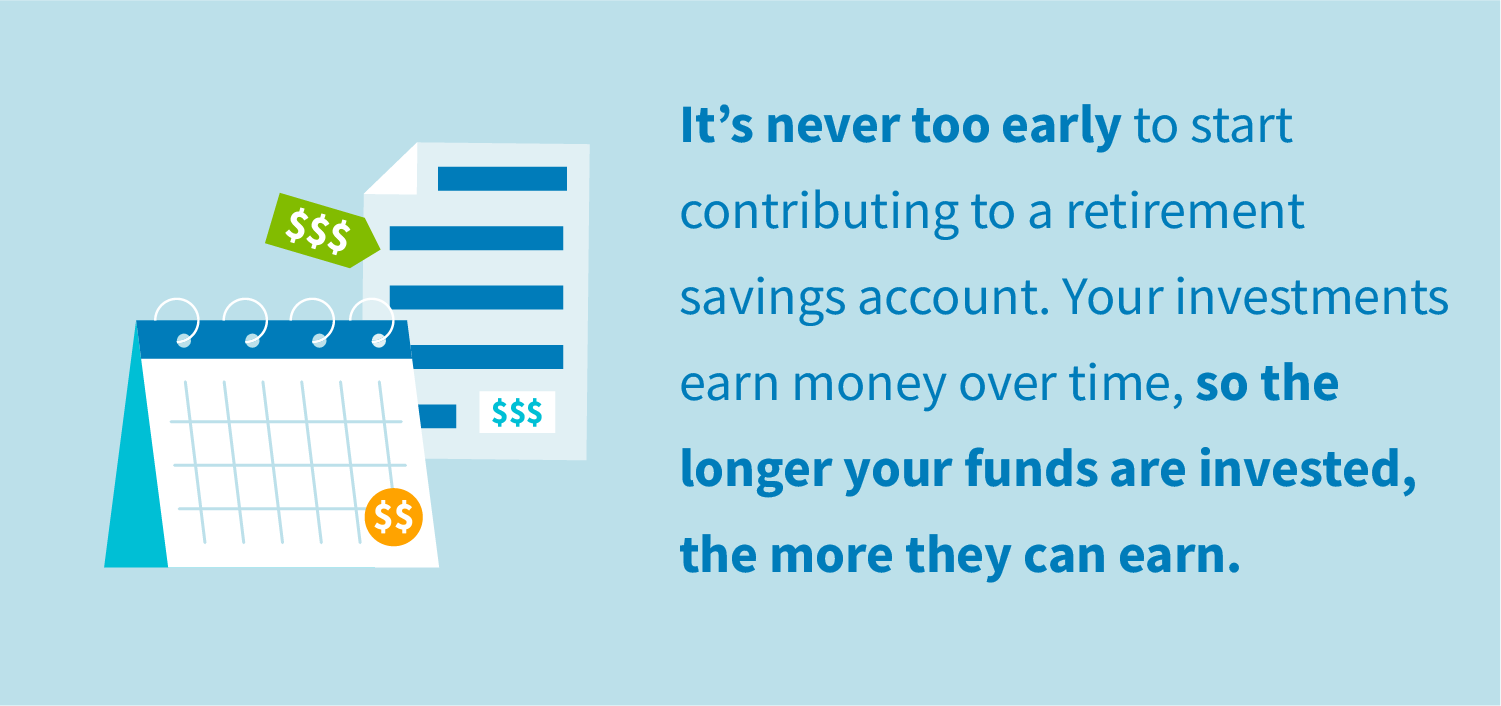
Prevailing wisdom when it comes to retirement savings is that it’s never too early to start contributing to a 401(k) or other retirement savings account. That’s because your investments earn money over time, so the longer your funds are invested, the more they can earn. Starting retirement planning as early as your twenties can mean you end up with much more money in retirement without actually paying more into your 401(k) yourself.
It's never too early to start contributing to a retirement savings account. Your investments earn money over time, so the longer your funds are invested, the more they can earn.
How much should you contribute?
Obviously, you need to contribute in a way that you can afford—you don’t want to starve yourself today so you can eat tomorrow. Here are some general rules for determining how much you should contribute to a 401(k):
- More is better. When saving, more is typically better as long as you can afford it. Take an honest look at your personal budget and consider cutting frivolous expenses where you can to save for your future.
- Consider company matching. One of the benefits of a 401(k) is that many companies match your contributions up to a certain percent of your salary. Find out what those limits are, and whenever possible, contribute up to that amount to maximize your savings. For example, if the employer will match contributions up to 3 percent of your salary, set your contributions to 3 percent to get a 6 percent total contribution.
- Know the contribution limits for each year. The IRS sets contribution limits for 401(k) plans every year. You can only contribute up to that amount and receive the tax benefits.
What are catch-up contributions?
Someone who is age 50 or older can exceed the IRS contribution limits for retirement savings by a certain amount each year and still get the tax benefits. This is allowed so that people who are close to retirement can “catch up” their retirement savings to appropriate levels if desired.
How do you contribute to a 401(k) plan?
Contributions are made to your plan by your employer, who deducts the amount you specify from your gross income. (The amount deducted can be either a dollar amount or a percentage of your income.)
Are there contribution limits?
The 2022 contribution limit for individuals is $20,500 if you're under 50 or $27,000 if you're 50 or older.
If your employer matches contributions, the amount they add to your 401(k) doesn't count towards your individual contribution limit.
What to do with your 401(k) if you leave your job
If you leave a job, voluntarily or otherwise, you have some options if your 401(k) amount is $5,000 or more. (If the amount is less, your employer may place your funds in an IRA account or write you a check for the amount.)
Here are some options to consider:
1. Move the 401(k) to a new employer
This is probably the most common course of action when moving to a new job. These plans are designed to be portable, so with very little friction, you can move the funds from your old 401(k) into your new employer's 401(k) plan.
2. Withdraw the money
If you have been laid off or are in financial distress, you may need to withdraw the funds. But perhaps not surprisingly, cashing out a retirement fund early isn't the most prudent financial choice and should be avoided if possible. There are a few reasons why:
- You'll lose the earning potential of having funds compound in a mutual fund over the course of decades.
- You'll pay income tax.
- In addition to income tax, you'll pay a 10 percent early withdrawal fee if you're 55 or younger.
3. Leave the 401(k) with your old employer
If your old employer allows it, you can leave the money in the plan. There are some downsides to this, however:
- You may simply forget your old account is still active.
- You may be unable to take out loans against your old plan.
- If your old employer goes out of business, there may be bureaucratic red tape to accessing these 401(k) funds.
Roll the money into an IRA
Rolling a 401(k) into an IRA allows you to guide what you do with your old funds without involving your new employer. Your funds stay tax-deferred, and if you have other old 401(k) plans, you can roll them into this central location as well. Some of the downsides are that you can't borrow against an IRA, and you may need to pay maintenance fees, depending on the IRA provider.
Other helpful 401(k) terms
Required Minimum Distributions
Once you reach a certain age, you have to receive a required minimum distribution (RMD) from your retirement plans each year. RMDs begin when you’re 72 if you’re born after July 1, 1949. For those born earlier than that date, RBDs began at age 70.5.
The amount of your RMD depends on how much you have in your retirement savings, among other factors. You must report your distributions as income on federal tax forms and pay any applicable income taxes on them. And, if you don’t take your RMD, you may have to pay an excise tax of 50 percent on the amount that you didn’t take.
Expense Ratios
Most 401(k) holders pay expense ratios. These are small fees taken by the management company in payment for services provided as they manage your retirement investments.
According to a TD Ameritrade study, the average expense ratio fees are around 0.45 percent of the retirement fund balance. That means if you have $500,000 in 401(k) savings, you pay roughly $2,250 annually in expense ratio fees. Many people don’t realize they pay such fees because it’s taken out of their 401(k) earnings, so it’s important to look at your statements regularly.
401(k) Loans
In some cases, you might find that you need your 401(k) funds to help with a current expense. Depending on your employer’s policies and those of your 401(k) account, you may be able to take out a loan against your 401(k).
Once you take out the loan, you make monthly payments on it. These are usually deducted from your paycheck and include interest. The total monthly payment is paid into your personal retirement fund.
Often, 401(k) loans are limited to certain types of expenses. Reasons for taking such a loan include covering the costs of buying a new home or education expenses.
One disadvantage of these loans is that it means those funds are no longer earning interest as an investment. Typically, the amount of interest you pay on the loan doesn’t make up for this fact, so loans can reduce how much you have when you get to retirement—which is less than ideal.
Preparing for retirement
It may not seem like it if you're fresh out of college or just starting your first job, but preparing for retirement is something you should consider even when it seems very far off. If you follow healthy retirement fund habits, you'll be thanking your younger self in your twilight years. CreditRepair.com can help you work on your credit now so you can prepare for your retirement.
Note: The information provided on CreditRepair.com does not, and is not intended to, act as legal, financial or credit advice; instead, it is for general informational purposes only.

If you need help, call the credit experts
learn more


FICO and “The score lenders use” are trademarks or registered trademarks of Fair Isaac Corporation in the United States and other countries.
** Your results will vary