
How to manage your credit cards

Disclosure regarding our editorial content standards.
Whether you just opened your first credit card or you’re trying to get your finances back on track, learning how to manage credit cards is a skill you’ll use again and again. Although some factors are outside your control, such as rising interest rates, you can manage your accounts by making on-time payments, paying more than the minimum due each month and keeping careful track of how much you owe.
Keep reading to learn more about how to manage credit cards in a way that maximizes your credit and helps you build a strong financial profile.
1. Secure your PIN and keep track of the terms of your credit cards
To prevent unauthorized access to your account, avoid sharing your PIN with other people or writing it down and leaving it where someone can see it. Once your PIN is secure, keep track of the terms of each credit card. Your accounts may have different interest rates, credit limits, foreign transaction fees and other terms.
2. Tally up your debt
Before you make any decisions about the best way to manage your credit, you need to understand how much debt you have. Take the time to add up the balances of every account, including credit cards, personal loans, auto loans, mortgages and lines of credit.
3. Identify your credit utilization ratio
Your credit utilization ratio measures how much credit you’ve used compared to how much credit you have. To calculate this ratio, you need to add up the balances on each of your revolving accounts.
A revolving account is a credit account that comes with a predetermined limit but can be reused when you pay it down. Credit cards and lines of credit are revolving accounts; mortgages and auto loans are not. Determine your total revolving balance and divide it by the total amount of revolving credit you have. If your total balance is $1,000 and you have $10,000 available in credit, your credit utilization ratio is 10 percent.
Experts say a good credit utilization ratio is less than 30 percent, but those with the best credit scores typically have rates in the seven-to-eight percent range.
Credit utilization is one of the most important components of your credit history because the amount of money you owe accounts for 30 percent of your FICO® scores. If your utilization ratio is high, lenders may view you as a high-risk borrower, making it difficult to qualify for new lines of credit.
4. Prioritize your debt
If you have a lot of debt, make it a priority to start paying it off. As you pay down your credit card balances, your minimum monthly payments will decrease, leaving you with more money to pay your living expenses. Paying down debt on time can also increase your credit score, which can help you qualify for a mortgage or auto loan when you need one.
5. Create a plan to pay off your debt
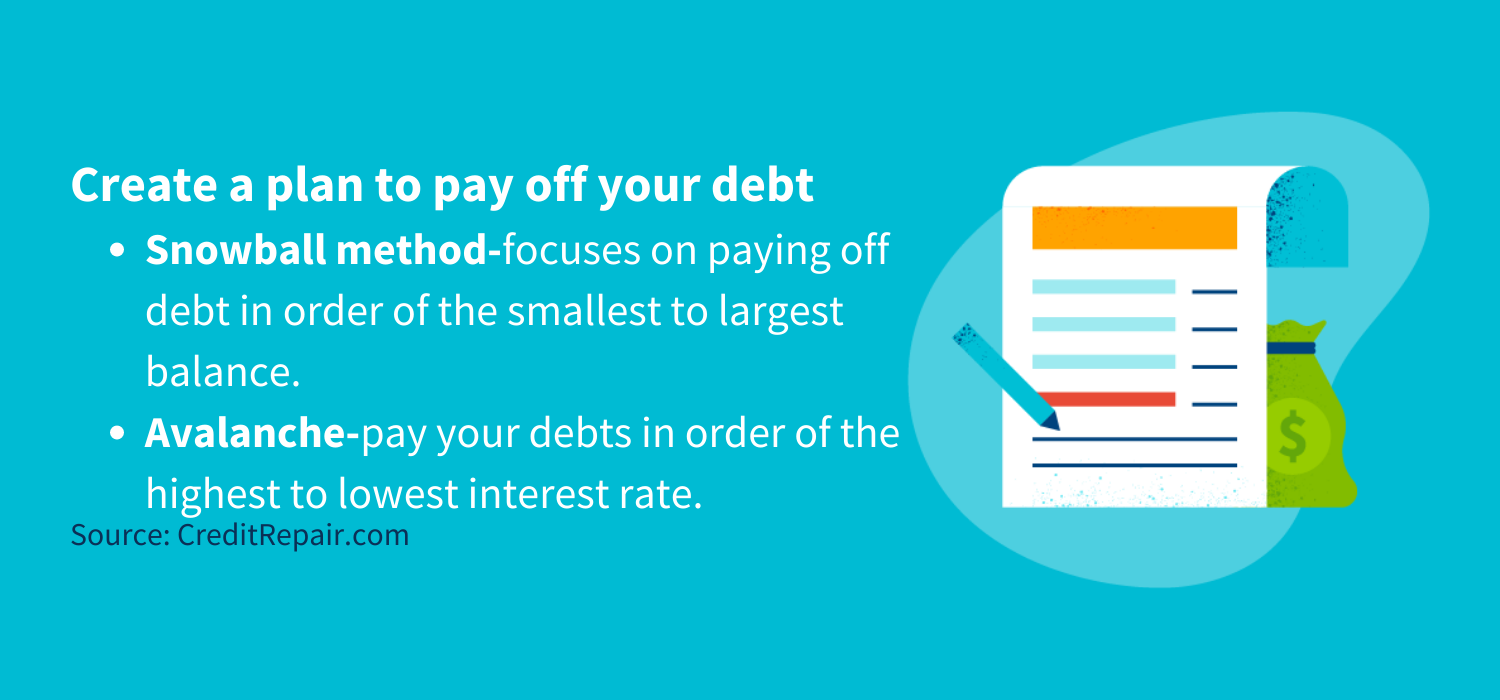
Now that you’re committed to paying off debt, there are a few ways to tackle your balances. The snowball method and the avalanche method are two of the most popular.
Snowball method
The snowball method focuses on paying off debt in order of the smallest to largest balance. Just as a snowball gets bigger as it rolls downhill, the amount of money you have available each month increases as you pay off each debt. This allows you to pay off your balances much faster than if you paid the minimum amount on each account every month.
Avalanche method
The snowball method only considers your account balances, not the interest rates on those accounts. With the avalanche method, you pay your debts in order of the highest to lowest interest rate. Paying off the account with the highest interest rate first reduces the amount of interest paid over time, potentially saving you money in the long run.
Snowball method vs. avalanche method
Both methods have pros and cons. With the snowball method, you experience a feeling of accomplishment every time you pay off a small balance, which can keep you motivated to continue paying off your debts. Because the snowball method doesn’t account for interest rates, however, you may pay more interest on accounts with higher balances while you’re paying off the smaller balances.
The avalanche method reduces the amount of money you spend on interest, but depending on which account has the highest interest rate, it may take a long time to pay off the first balance. Some people get discouraged when it takes such a long time to make progress, so be sure to watch out for that feeling if you choose the avalanche method.
6. Consider consolidating your debt
Debt consolidation allows you to roll your balances into one loan. It doesn’t erase your debts, but it does make them easier to manage. Instead of having to keep track of multiple payment amounts and due dates, you’ll make just one monthly payment on the consolidation loan.
If you decide to consolidate your debts, make sure you understand the terms of the consolidation program before you apply. Some programs have hidden fees or high interest rates, which can make consolidation more expensive than paying off your debts one at a time.
7. Avoid late and minimum payments
Your payment history is the most important part of your FICO® score. On-time payments show lenders that you use credit responsibly, and late payments make you more of a risk to credit card companies and banks. To keep your score as high as possible, make your payments on time every month. If necessary, add a reminder to your online calendar or set up text alerts from each company to remind you when the payment date is approaching.
Your minimum payment is the minimum amount you must pay each month to keep your account in good standing. Although you’re not required to pay more than the minimum, paying as much as possible can help you pay off debt faster and reduce the amount of interest owed.
8. Watch out for recurring payments that draw from your credit card
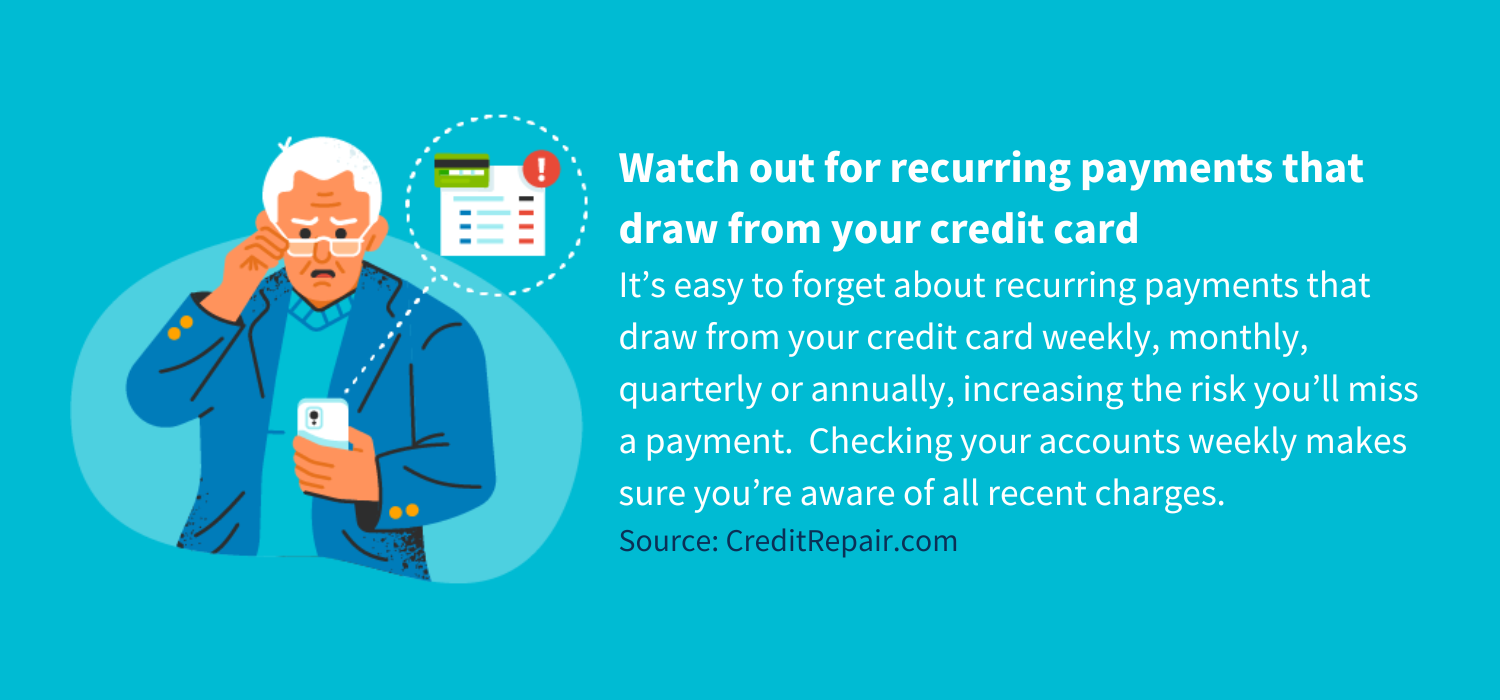
As you learn how to manage credit cards, consider getting into the habit of checking your accounts at least once per week. It’s easy to forget about recurring payments that draw from your credit card weekly, monthly, quarterly or annually, increasing the risk you’ll miss a payment.
Checking your accounts weekly makes sure you’re aware of all recent charges. It can also help you spot fraud right away, making it easier to get your credit card company to take steps to protect your account and mitigate any damage.
9. Track your progress
Tracking your progress is a great way to stay motivated as you learn how to manage credit cards and other forms of debt. Some people use a basic spreadsheet, while others use custom debt trackers for a visual reminder of how far they’ve come.
10. Practice healthy money management when possible
As you build your credit, it’s important to get good at managing your money. To keep track of your expenses, set up a monthly budget that includes your rent/mortgage payment, credit card payments, loan payments, utilities, groceries and other items. Don’t forget to include streaming services, magazine subscriptions and other expenses.
This can help you keep track of what you owe and determine if you have any opportunities to reduce your spending.
In January 2022, CNBC released a report indicating that 56 percent of Americans don’t have enough savings to cover a $1,000 emergency. To make it easier to pay for unexpected car repairs, broken appliances and other unanticipated expenses, keep some of your savings if possible in an emergency fund that you access only when absolutely necessary.
Using credit cards appropriately is also a good way to manage your finances. Some cards offer cash back on purchases, and others provide product discounts or other financial perks.
To minimize your expenses and maximize your savings, match your credit card usage with your spending habits. If one credit card is offering five percent cash back on gasoline purchases, for example, use that card each time you fill up your tank. For limited-time offers, make sure you make a qualifying purchase before the deadline.
A healthy credit report can support healthy credit usage
With a healthy credit report, it’s easier to qualify for new lines of credit, lower interest rates and higher limits. If you need help improving your credit, reach out to CreditRepair.com.
Note: The information provided on CreditRepair.com does not, and is not intended to, act as legal, financial or credit advice; instead, it is for general informational purposes only.




FICO and “The score lenders use” are trademarks or registered trademarks of Fair Isaac Corporation in the United States and other countries.
** Your results will vary